import pandas as pd
from IPython.display import Markdown

"""ML-DSA parameter sets, as given in Table 1 of FIPS 204."""

from dataclasses import dataclass


@dataclass
class MLDSAParams:
    name: str
    n: int       # ring degree, always 256
    q: int       # modulus
    tau: int     # number of +-1's in the challenge poly c
    gamma1: int  # y coefficient range
    gamma2: int  # low-bits rounding range
    k: int       # rows of A (dimension of w, s2, t)
    l: int       # columns of A (dimension of s1, z)
    eta: int     # secret key coefficient range
    d: int       # dropped bits of t
    omega: int   # maximum number of hints

    @property
    def beta(self) -> int:
        return self.tau * self.eta


# FIPS-204 Table 1
PARAMS = [
    MLDSAParams("ML-DSA-44", n=256, q=8380417, tau=39, gamma1=2**17,
                gamma2=(8380417 - 1) // 88, k=4, l=4, eta=2, d=13, omega=80),
    MLDSAParams("ML-DSA-65", n=256, q=8380417, tau=49, gamma1=2**19,
                gamma2=(8380417 - 1) // 32, k=6, l=5, eta=4, d=13, omega=55),
    MLDSAParams("ML-DSA-87", n=256, q=8380417, tau=60, gamma1=2**19,
                gamma2=(8380417 - 1) // 32, k=8, l=7, eta=2, d=13, omega=75),
]


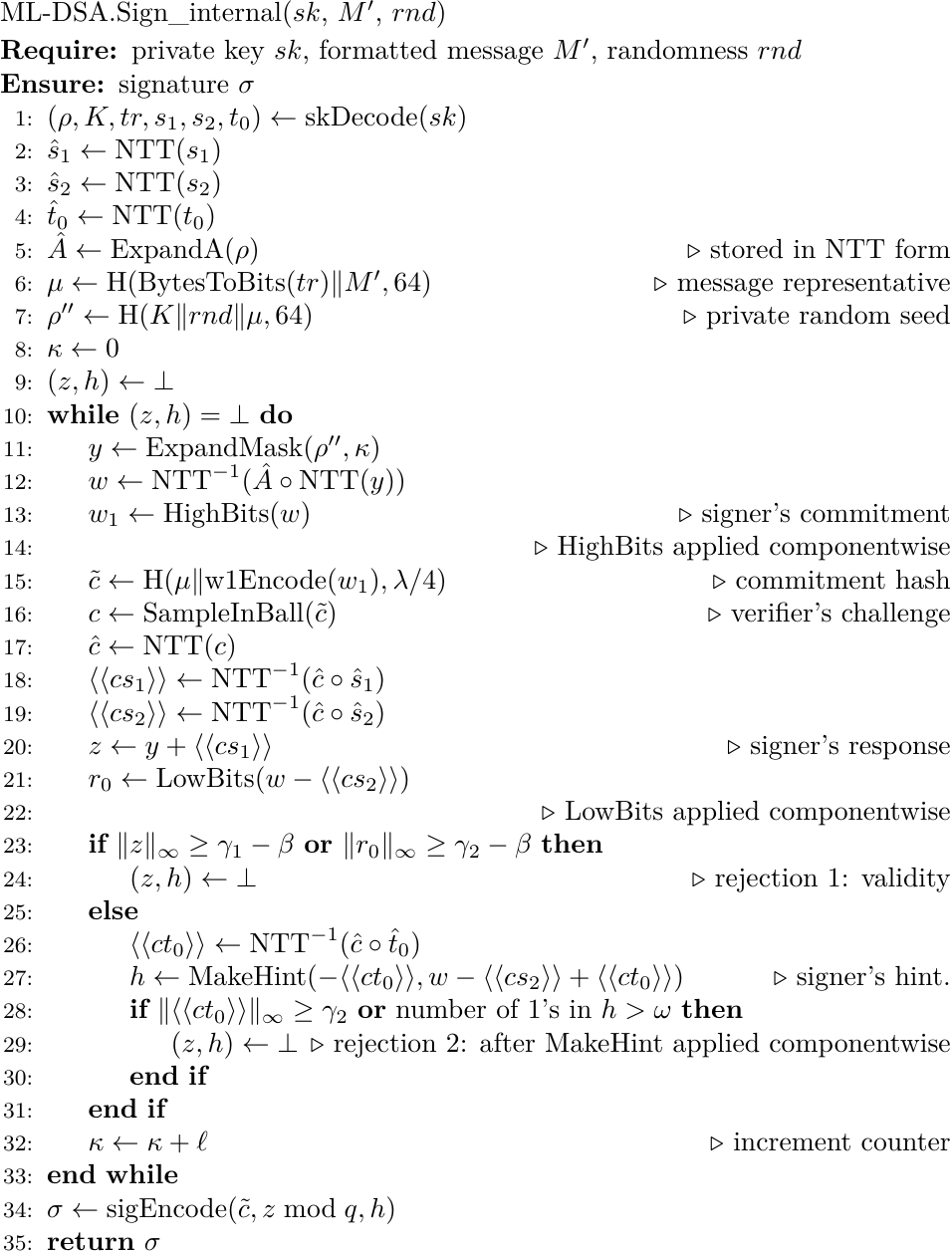
"""P_hint for ML-DSA: probability that a signing attempt is rejected on line 28
of FIPS 204 Algorithm 7 because it produced more than omega hints.

Monte Carlo. Per-coefficient hint probability is conditioned on line 23
having passed (|r0| < gamma2 - beta). a = |(c*t0)_i| alone does not determine
whether the hint fires: the count is a-beta-1 if (c*t0)_i = +a, a-beta if
(c*t0)_i = -a (the window (-gamma2, gamma2] is open at one end, closed at the
other, so the two signs are not interchangeable). Since t0 is symmetric about
zero, the sign is a fair coin flip given a, so the per-coefficient probability
is the average of the two:

    P(hint | a) = max(0, a - beta - 1/2) / (2*(gamma2 - beta) - 1),  a = |(c*t0)_i|
"""

import math

import numpy as np

# No import of params.py here: this module has no import-time dependency
# on it, so it stays executable whether imported as a package module or
# spliced inline into a notebook cell. run_simulation() below takes the
# parameter list as an explicit argument instead of defaulting to it.

PSI = np.exp(1j * np.pi * np.arange(256) / 256)
IPSI = np.conj(PSI)


def p_hint(k, tau, d, gamma2, beta, omega, trials, batch=2000, seed=19820116):
    """Monte Carlo estimate of P(N > omega), N = number of hints that fire."""
    rng = np.random.default_rng(seed)
    half = 2 ** (d - 1)
    denom = 2 * (gamma2 - beta) - 1
    total_hints = rejected = done = ct0_rej = 0

    while done < trials:
        b = min(batch, trials - done)

        # Step 1: sample c
        c = np.zeros((b, 256))
        # Spread tau's among 256 positions
        pos = np.argsort(rng.random((b, 256)), axis=1)[:, :tau]
        # Map {0,1} to {-1,+1} and put in chosen positions.
        np.put_along_axis(c, pos,
                          (rng.integers(0, 2, size=(b, tau)) * 2 - 1).astype(float),
                          axis=1)

        # Step 2: sample t0 uniform on (-2^(d-1), 2^(d-1)];
        t0 = rng.integers(-half + 1, half + 1, size=(b, k, 256)).astype(float)

        # Step 3: compute c*t0 in Z[X]/(X^256+1) via negacyclic FFT
        ct0 = np.real(np.fft.ifft(np.fft.fft(t0 * PSI, axis=2)
                                  * np.fft.fft(c * PSI, axis=1)[:, None, :],
                                  axis=2) * IPSI)
        # Number of rejected ct0. We expect 0
        ct0_rej += int((np.abs(np.rint(ct0)).max(axis=(1, 2)) >= gamma2).sum())
        assert np.abs(ct0 - np.rint(ct0)).max() < 1e-6, "FFT lost integer precision"

        # Step 4: compute hint probability
        prob = np.maximum(0, np.abs(np.rint(ct0)) - beta - 0.5) / denom
        n_hints = (rng.random(prob.shape) < prob).sum(axis=(1, 2))
        total_hints += int(n_hints.sum())

        # Step 5: Number of rejected hints
        rejected += int((n_hints > omega).sum())
        done += b

    est = rejected / done
    return total_hints / done, est, math.sqrt(est * (1 - est) / done), ct0_rej


def p_hint_compare(k, tau, d, gamma2, beta, omega, trials, batch=2000, seed=19820116):
    """Monte Carlo comparison of P_hint under the conditioned model (this note)
    against the unconditioned model Yan, Luo and Wang use for this term, on
    shared (c, t0, u) draws so the comparison is a paired one and not itself
    noisy on top of the two individual estimates.

    Conditioned:   P(hint at i | a) = max(0, a - beta - 1/2) / (2*(gamma2-beta) - 1)
    Unconditioned: P(hint at i | a) = min(1, a / (2*gamma2))

    Returns (p_cond, p_uncond, se_cond, se_uncond).
    """
    rng = np.random.default_rng(seed)
    half = 2 ** (d - 1)
    denom_cond = 2 * (gamma2 - beta) - 1
    denom_uncond = 2 * gamma2
    rejected_cond = rejected_uncond = done = 0

    while done < trials:
        b = min(batch, trials - done)

        c = np.zeros((b, 256))
        pos = np.argsort(rng.random((b, 256)), axis=1)[:, :tau]
        np.put_along_axis(c, pos,
                          (rng.integers(0, 2, size=(b, tau)) * 2 - 1).astype(float),
                          axis=1)
        t0 = rng.integers(-half + 1, half + 1, size=(b, k, 256)).astype(float)
        ct0 = np.real(np.fft.ifft(np.fft.fft(t0 * PSI, axis=2)
                                  * np.fft.fft(c * PSI, axis=1)[:, None, :],
                                  axis=2) * IPSI)
        a = np.abs(np.rint(ct0))

        prob_cond = np.maximum(0, a - beta - 0.5) / denom_cond
        prob_uncond = np.minimum(1, a / denom_uncond)

        u = rng.random(a.shape)
        n_cond = (u < prob_cond).sum(axis=(1, 2))
        n_uncond = (u < prob_uncond).sum(axis=(1, 2))

        rejected_cond += int((n_cond > omega).sum())
        rejected_uncond += int((n_uncond > omega).sum())
        done += b

    p_cond = rejected_cond / done
    p_uncond = rejected_uncond / done
    se_cond = math.sqrt(p_cond * (1 - p_cond) / done)
    se_uncond = math.sqrt(p_uncond * (1 - p_uncond) / done)
    return p_cond, p_uncond, se_cond, se_uncond


def p_hint_normal_compare(k, tau, d, gamma2, beta, omega, trials, batch=2000, seed=19820116):
    """Compare the true (simulated) P_hint against a normal approximation
    that uses N's correct mean and variance (both estimated from the same
    trials), to quantify how much the normal approximation underestimates
    the tail - the correlation between coefficients of one c*t0 polynomial
    (Step 3 in the 'why there is no usable formula' argument) fattens the
    true upper tail beyond what a normal with the right variance predicts.

    Returns (mean, sigma, p_true, p_normal).
    """
    rng = np.random.default_rng(seed)
    half = 2 ** (d - 1)
    denom = 2 * (gamma2 - beta) - 1
    done = 0
    sum_n = sum_n2 = 0.0
    rejected = 0

    while done < trials:
        b = min(batch, trials - done)
        c = np.zeros((b, 256))
        pos = np.argsort(rng.random((b, 256)), axis=1)[:, :tau]
        np.put_along_axis(c, pos,
                          (rng.integers(0, 2, size=(b, tau)) * 2 - 1).astype(float),
                          axis=1)
        t0 = rng.integers(-half + 1, half + 1, size=(b, k, 256)).astype(float)
        ct0 = np.real(np.fft.ifft(np.fft.fft(t0 * PSI, axis=2)
                                  * np.fft.fft(c * PSI, axis=1)[:, None, :],
                                  axis=2) * IPSI)
        a = np.abs(np.rint(ct0))
        prob = np.maximum(0, a - beta - 0.5) / denom
        n_hints = (rng.random(prob.shape) < prob).sum(axis=(1, 2))
        sum_n += n_hints.sum()
        sum_n2 += (n_hints.astype(np.float64) ** 2).sum()
        rejected += int((n_hints > omega).sum())
        done += b

    mean = sum_n / done
    sigma = math.sqrt(sum_n2 / done - mean ** 2)
    p_true = rejected / done
    # continuity-corrected normal tail
    z = (omega + 0.5 - mean) / sigma
    p_normal = 0.5 * math.erfc(z / math.sqrt(2))
    return mean, sigma, p_true, p_normal


def mean_hint_count(k, tau, d, gamma2, beta):
    """ Mean hint count E[N] for ML-DSA, analytically.

    N is the number of 1 bits in the hint vector h (FIPS 204 Alg 7, line 27).
    Its mean follows from linearity of expectation, which holds whether or not
    the coefficients are independent -- unlike the tail P(N > omega), which
    depends on the joint distribution and has no tractable closed form.

        E[N] = sum over coefficients of P(hint at i)
            = 256*k * E[ max(0, |c*t0_i| - beta - 1/2) ] / (2*(gamma2-beta) - 1)

    The per-coefficient probability is conditioned on line 23 having passed,
    which confines r0 to |r0| < gamma2 - beta, and averaged over the sign of
    c*t0_i (a fair coin flip given its magnitude, by t0's symmetry). See the
    companion note.

    A coefficient of c*t0 is a sum of tau terms +-t0_j with t0_j uniform over
    2^d values, so it is zero-mean with

        sigma = 2^d * sqrt(tau/12)      and      E|X| = sigma * sqrt(2/pi)

    Since beta/sigma is between 0.005 and 0.012 for all parameter sets, |X|
    exceeds beta in all but a negligible fraction of cases, so

    E[ max(0, |X| - beta - 1/2) ] ~= E|X| - beta - 1/2
    """

    sigma = 2 ** d * math.sqrt(tau / 12)        # spread of a c*t0 coefficient
    e_abs = sigma * math.sqrt(2 / math.pi)      # E|X| for a zero-mean Gaussian
    per   = (e_abs - beta - 0.5) / (2 * (gamma2 - beta) - 1)
    return 256 * k * per, sigma, e_abs, per


def run_simulation(trials, params):
    """Run the Monte Carlo for every parameter set and print a summary table.

    `params` is the list of MLDSAParams to run (see params.py) - passed in
    explicitly rather than defaulted, so this module stays decoupled from
    params.py.
    """
    phint = dict()
    for p in params:
        sim, est, se, ct0_rej = p_hint(p.k, p.tau, p.d, p.gamma2, p.beta, p.omega, trials)
        print(f"{p.name}: P_hint = {est:.5f} +- {se:.5f} - {sim:.2f} - {ct0_rej}")
        phint[p.name] = [sim, est, se]

    hdr = (f"{'variant':<12}{'omega':>7}{'sigma':>9}{'E|X|':>9}{'per-coeff':>12}"
        f"{'E[N]':>9}{'simulated':>11}")
    print(hdr)
    print("-" * len(hdr))
    for p in params:
        lam, sigma, e_abs, per = mean_hint_count(p.k, p.tau, p.d, p.gamma2, p.beta)
        print(f"{p.name:<12}{p.omega:7d}{sigma:9.0f}{e_abs:9.0f}{per:12.5f}"
              f"{lam:9.2f}{phint[p.name][0]:11.1f}")
    return phint


# Running 100M trials per parameter set at site-build time would be
# impolite - it takes on the order of hours. Regenerated after the
# conditioned per-coefficient formula moved from a-beta-1 to a-beta-1/2
# (see @sec-hint) with:
#   python3 -m mldsa_rejection.run_phint --trials 20000000 --json result.json
#
# variant            trials  E[N] sim  E[N] analytic    P_hint   std err  seconds
# -------------------------------------------------------------------------------
# ML-DSA-44        20000000     63.07          62.98   0.01458   0.00003    480.1
# ML-DSA-65        20000000     38.23          38.19   0.00380   0.00001    714.7
# ML-DSA-87        20000000     56.75          56.70   0.00785   0.00002    917.6
P_HINT = {
    "ML-DSA-44": (63.07, 0.01458, 0.00003),
    "ML-DSA-65": (38.23, 0.00380, 0.00001),
    "ML-DSA-87": (56.75, 0.00785, 0.00002),
}

df = pd.DataFrame([
    {
        "**Variant**": p.name,
        "**Mean hint count**": f"{P_HINT[p.name][0]:.1f}",
        r"$\omega$": p.omega,
        r"$P_{\mathrm{hint}}$": f"{P_HINT[p.name][1]:.5f} ± {P_HINT[p.name][2]:.5f}",
    }
    for p in PARAMS
])

Markdown(df.to_markdown(index=False, disable_numparse=True, colalign=("left", "left", "left", "left")))